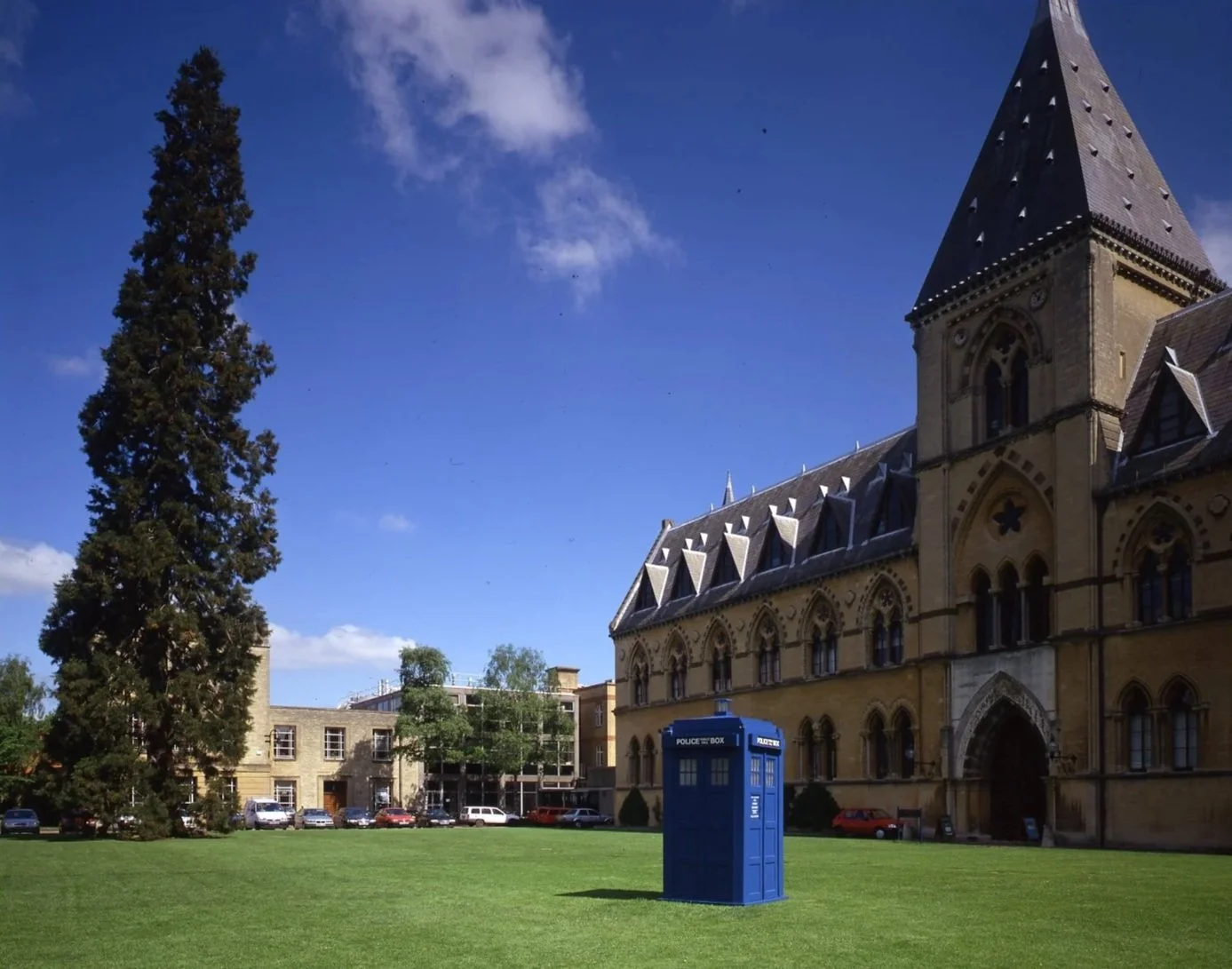
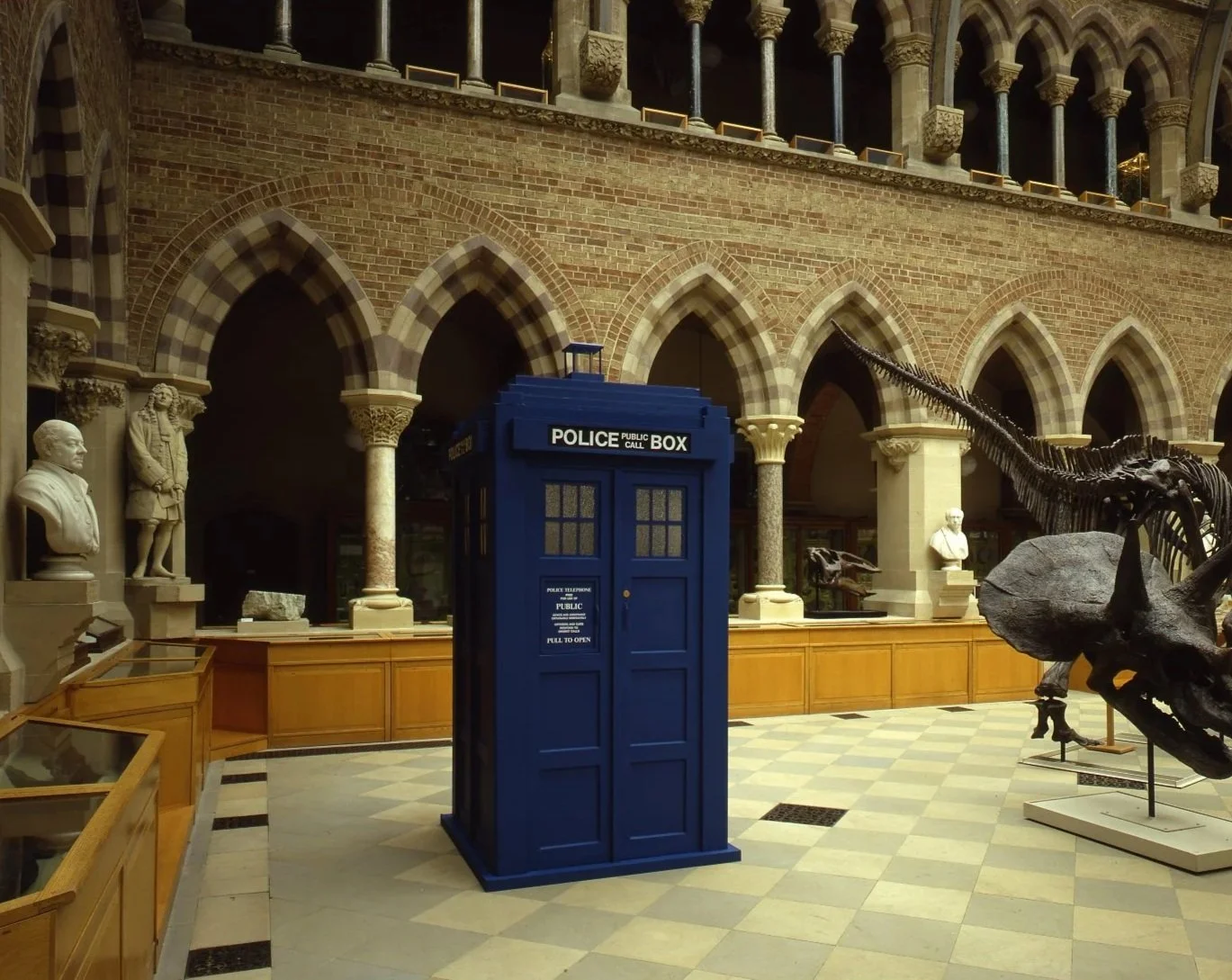
Time and Relative Dimensions in Space (TARDIS), 2001
Oxford University Museum of Natural History
Another Time, Another Place by Marco Livingstone
Mark Wallinger began his residency at Oxford University Museum of Natural History in June 2000, meeting the curators and visiting ‘in fits and bursts’ on seven or eight occasions, sometimes for a week at time, over the next nine months. It was one of many artist placements in a variety of venues, some more unlikely than others, all over the country as part of the designated Year of the Artist. Although Wallinger did not regard this particular museum as an obvious place in which to work, he thought it would be a challenge that could be ‘useful or interesting’.

It was understood from the beginning that at the end of his residency he would present work for exhibition. ‘I’ve always had a beady eye on the lawn in front of the museum,’ says Wallinger, ‘I think partly because Oxford is full of quads and courtyards, and this seemed to be the only one publicly available. I quite liked the museum façade and the sequoia tree as a backdrop. I was sort of set on that early on. I think I probably soon came to the conclusion that nature in all its forms is far too strange to compete with, in terms of a regular display in the institution. I didn’t want to fall into that business of putting things into vitrines, the kind of rhetoric which has been adopted by many other artists. But I didn’t think a painting would look any good, either. I was kind of hoping at some point that a leap of the imagination would happen. I didn’t want to illustrate the workings of the museum; I have no expertise in that area. I didn’t want to come over as an amateur geologist or something. I was looking for something that had a metaphorical engagement with what the museum as a whole seemed to be saying to me, or the things that I found potent.’
The museum struck Wallinger as the sort of place that children love visiting, so he wanted to produce something that was playful and immediately engaging, but that might have some kind of poetic link to the institution. During the early part of his residency, he was making an edition of potato-cut prints depicting beetles, as one of a portfolio of Bugs to be sold in aid of the Byam Shaw School of Art in London, and for a while he considered the possibility of taking beetles as the subject for his Oxford exhibition. In the end, however, he decided to abandon this, perhaps because it was too predictable a link to the institution, and to do something radically different instead.
The idea of producing something that would appeal to the imagination of children, and to the child still lurking within him and other adults, became fused with the concept of the museum as a global repository of time and memory. Rather than demonstrating these themes in an earnest or didactic way, he has decided to make them manifest in an object familiar to him – and many others of his generation – from years of watching television: the TARDIS from Doctor Who. In fact, not just one, but two TARDISES, reproduced ‘life-size’, make up the work, to which he has given the title from which the acronym of this strange vehicle was derived: Time and relative dimensions in space. They were ordered from a manufacturer in Cheshire that was already producing these items as memorabilia for Doctor Who fans. He is well aware that the low-brow reference to a rather charmingly inept and now dated children’s programme may raise eyebrows in the high-brow setting of Oxford, but it was this very clash of cultural references that appears to have spurred him on. ‘Popular culture,’ as Wallinger observes, ‘is not normally allowed that kind of anthropology.’
One of the TARDISES is placed on the lawn outside the museum, as if it had just arrived there; the other is tucked away in an unlikely part of the building’s interior, so that visitors come across it when they would least expect to. Since they are not visible at the same time, the implication is that it might be the same object that has migrated from one location to the other. There are no sound effects to accompany it, since the ‘whooshing’ noise heard in the programme occurred only when the TARDIS was about to take off and the artist does not wish ‘to raise false expectations’. Wallinger’s TARDISES are very firmly planted, at least for the duration of the exhibition. Habitual visitors to the museum will find that these mysterious visitors have just landed there one day, and they will just as suddenly disappear.
The TARDIS is a slightly preposterous object in itself. It resembles a telephone kiosk, but was actually adapted from a police box designed in 1929, an object that was a familiar part of the street furniture in British cities until the very end of the 1960s, when the last ones were decommissioned. ‘I love it as an object,’ Wallinger explains, ‘because it is built to look as if it has four double-doors on each side, which is an absurdity. It is a bit like a conjuring prop. Only one door ever worked.’ His fascination with the police box, which reminded him of the iconic phone box designed by Giles Gilbert Scott, but which for him also suggested the atmosphere of the Victorian era, led him to visit the Police Museum in Charlton, where he tracked down the original design.
While the unexpected sighting of the TARDIS on the grounds of the country’s most esteemed university might make one laugh, it is a surprisingly apt metaphor for the institution it accompanies. After all, the University Museum of Natural History is itself a kind of time capsule, covering millennia of the earth’s past. Like the mythical science-fiction hut, a small construction whose doors open to a surprisingly vast interior, the building houses a far larger collection of objects than one would have thought possible when approaching it from the outside. Wallinger was amused to observe, moreover, that the museum appears to have no doors large enough to accommodate some of the enormous specimens held inside. Were the dinosaurs brought in bone by bone, and reconstructed in the interior like a giant ship in a bottle?
The decision to buy and install two examples of a ‘replica’ TARDIS, cast in fibreglass, compounds the absurdity of Wallinger’s spin on the ready-made, especially as the ‘original’ TARDIS was itself just a stage prop, a copy of a real object cast in concrete. The French Dadaist Marcel Duchamp had devised his first ‘ready-mades’, including a bicycle wheel attached to a kitchen stool redesignated as a work of art, in 1913; he invented the term two years later to describe any prefabricated object raised to the status of art by the simple fact of an artist having selected it, developing a new thought or identity for that object. While the ready-made now has a long and honourable history, with many recent appearances in the work of the ‘young British artists’ of his own generation, Wallinger’s use of it here is particularly idiosyncratic. ‘In terms of the ready-made, I think it is more like the unicorn I am currently making, an animal everybody recognises, but that doesn’t exist, than Duchamp’s bicycle wheel. It edges towards myth. If you show a picture of this to somebody, they are more likely to say it’s a TARDIS than a police box.’
‘There is a slight autobiographical thing that I try to get into the work which is not very overt. I like the idea that it’s a time machine, because I think the museum is a bit like a time machine, but also the notion that the experience of the building is far larger than the bricks and mortar of the outside. It just appealed to me. Especially for people of a certain age, to have that object on the lawn, with the associations of where and when it might come from. I decided to make it more playful and to have another one inside the museum, but in a position where you couldn’t see them both at once: it might have moved! I also liked the fact that for the uninitiated, it was quite an opaque kind of object. There is something about it that demands a certain kind of research, perhaps, in the inscrutable nature of a dodo in a case?’
The ready-made is not a new feature of Wallinger’s work, which has encompassed painting, sculpture, photography, video and installation. An early sculpture, Booty of 1987, consisted of a velvet-covered pub table used as a plinth for a hollowed-out elephant foot sprouting an opened umbrella, with a clockwork train travelling in an endless circle around its periphery; in 1992 he inserted a hose spewing water through the plate-glass window of the Anthony Reynolds Gallery in London, titling it Fountain in homage to the Duchamp urinal of 1917; in his 1994 video installation Royal Ascot, he presented four monitors side-by-side playing recordings he had made off the television; and with his tongue even more firmly in his cheek, in 1994 he designated an actual racehorse which he part-owned as A Real Work of Art. As far as the replica TARDIS is concerned, Wallinger liked the fact that it was a mute, non-functional object with an impenetrable exterior surface. Like much of the work he is making at the moment, it is both insistently there and invisible or in some way obscured from view. In its blunt physical presence as a work of art, it predicts the two extremes of viewer response: ‘Either you get it, or it’s totally opaque’.
The very first instalment of Doctor Who, Wallinger recalls, had a kind of Promethean theme, showing cavemen struggling without fire. The backdrop afforded by the museum’s lone sequoia tree thus seems strangely fitting, not only because this species of giant coniferous tree can live for several thousand years but also because, as a native of California, its presence on an Oxford lawn is particularly incongruous and unexpected, as if this natural object, too, had landed there from another time and another place.
The link Wallinger forges with his own past through the Doctor Who reference makes the work, in his view, almost part of his own ‘archaeology’, a parallel to the function of the museum itself in unearthing fragments of the past and making them part of the mental landscape of the present. Through the admittedly very simple means chosen by the artist, allusion is made to the recovery of things that have disappeared. It is not just a question of physical objects, but also of something more intangible but equally real: memory and experience. By appropriating an object of fantasy from his misspent youth in front of the television, Wallinger also recuperates part of his childhood. Although the production of the Doctor Who programmes has ceased, and some of the performers who incarnated the main character are no longer alive, the old episodes are of course endlessly recycled on cable television and sold as videos. People of a certain age may well experience the same involuntary tinge of nostalgia on seeing the TARDIS ‘in person’ as on viewing again a programme they had watched as children. For a younger audience getting to know the TV series for the first time, there should be the innocent thrill of discovering a familiar object of fantasy translated from the screen into the three dimensions of the real world. With any science fiction, the story takes hold on the viewer’s mind only to the extent that he or she can project him or herself into the space depicted. The sensation induced by Wallinger’s work will be of having pierced that screen that separates the mundane world we inhabit from the realm of fantasy and imagination beyond.
Marco Livingstone is a freelance writer and curator
Link for further information.